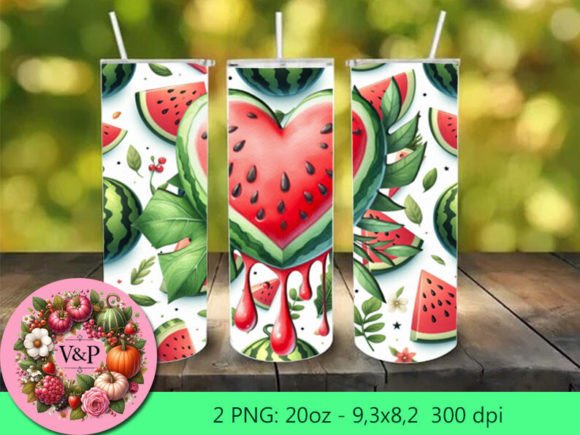
Watercolor Watermelon Skinny Tumbler Graphics & Tumbler Wraps
As a brand designer who’s developed visual identities for over 40 local businesses—from artisanal coffee roasters in Asheville to handmade soap studios in Portland—I recently evaluated the Watercolor Watermelon Skinny Tumbler for a real client project: a seasonal summer launch for “Sunbeam Botanicals,” a small-batch skincare brand serving farmers’ markets and boutique gift shops across the Pacific Northwest.
My first impression? It’s refreshingly cohesive—not just “cute,” but intentionally evocative. The soft granulation, gentle pigment bleed, and subtle white space in the watercolor texture suggest organic authenticity and handcrafted care. It reads as joyful without being juvenile, summery without leaning into cliché, and feminine without excluding broader appeal. This isn’t generic clipart—it’s a considered graphic design asset that leans into warmth, approachability, and lightness—ideal for brands rooted in wellness, food, florals, or slow-living values.
A Versatile Anchor for Local Business Branding
The Watercolor Watermelon Skinny Tumbler shines where small business branding needs both personality and practicality. For Sunbeam Botanicals, we used it not just on tumbler wraps—but as a unifying motif across touchpoints: scaled down for product labels on lavender mist sprays, enlarged as a hero graphic behind their summer newsletter signup, softened as a watermark on thank-you cards, and layered beneath hand-lettered typography on farmers’ market posters.
In packaging design, it adds instant shelf appeal—especially when paired with kraft paper tubes or matte-finish glass jars. As a decorative brand element, it supports stronger visual hierarchy: the watercolor pattern recedes just enough to let key info (ingredient callouts, scent names, “Small Batch” badges) step forward. That balance builds customer trust—it signals attention to detail, not just decoration.
Where It Elevates Real Business Presentation
- Product labels: Works beautifully as a border or background wash on 2 oz. serum dropper labels—adds dimension without overwhelming fine print.
- Packaging accents: Printed on belly bands for candle boxes or sticker seals for soap bundles—creates tactile cohesion across SKUs.
- Social media graphics: Scales cleanly for Instagram carousels and Pinterest pins; the PNG transparency allows seamless blending over lifestyle photos.
- Seasonal campaign visuals: Anchors limited-edition bundles (“Summer Glow Kit”) and pop-up event banners—feels timely but not disposable.
- Printable inserts: Used as a subtle background on recipe cards inside tea tins or care instructions tucked into tote bags—reinforces brand voice quietly.
Where Caution Is Warranted
This asset thrives in expressive, human-centered contexts—but it’s not universally adaptable. Avoid placing it directly behind dense legal text (e.g., FDA-mandated ingredient lists), where legibility suffers. It’s less effective on ultra-minimalist luxury brands that rely on stark negative space or monochrome palettes. And while it holds up well at medium sizes, I’ve seen it lose definition on sub-1-inch hang tags unless simplified or isolated to a single watermelon slice motif.
Crucially, it shouldn’t compete with your logo design. Use it as a supporting design asset, not a replacement for clear, scalable brand marks. In crowded retail environments—like craft fairs where 20+ booths use watercolor motifs—it benefits from intentional contrast: pairing it with bold sans-serif type or unexpected accent colors (think terracotta or deep sage) to ensure product recognition.
Practical Designer Notes You Can’t Skip
Before committing to production, here’s what I test every time—with the Watercolor Watermelon Skinny Tumbler specifically:
- Mockup realism: Drop it into a physical tumbler mockup *and* a flat label template—does the scale feel balanced? Does the taper alignment match your chosen vessel?
- Black-and-white fidelity: Print a grayscale version—does the pigment variation translate, or does it flatten into muddy gray?
- Font pairing: Try it beside serif (e.g., Playfair Display), sans-serif (e.g., Inter), script (e.g., Pacifico), and display fonts (e.g., Bungee). It harmonizes best with soft serifs and airy sans-serifs—not heavy display or tight monospaced styles.
- Color integration: Overlay your brand’s primary palette—does the watercolor’s natural pink/green base complement or clash with your secondary hues?
- Licensing clarity: Verify the commercial license explicitly permits use on physical products sold to end customers—not just digital previews or social posts.
- File integrity: Confirm the PNG has clean transparency (no stray pixels or haloing) and that vector/SVG versions—if offered—are editable without distortion.
- Competitor context: Place it beside 3–5 similar products in your category. Does it stand out for craftsmanship—or blend into visual noise?
More Than a Digital Download—A Brand Alignment Tool
What makes the Watercolor Watermelon Skinny Tumbler valuable isn’t just its aesthetic—it’s how efficiently it bridges brand strategy and execution. For a local bakery launching “Watermelon Mint Lemonade” tumblers, it instantly communicates flavor, seasonality, and handmade charm. For a children’s boutique adding summer-themed reusable bottles, it adds playful sophistication without cartoonishness. That flexibility is rare in digital product assets sourced from creative marketplaces.
Used thoughtfully, it strengthens small business branding by making consistency effortless: same texture on a sticker, same mood on a website banner, same warmth on a product mockup. That repetition builds familiarity—and familiarity builds loyalty. In an era where consumers choose local for authenticity, this kind of intentional, human-scaled marketing visuals doesn’t just decorate—it connects.
If you’re sourcing Tumbler Wraps or Graphics for real-world business use, treat them like strategic tools—not just pretty files. The Watercolor Watermelon Skinny Tumbler earns its place when it serves your story, supports your audience’s expectations, and elevates every surface it touches—from a $3 sticker to a $45 gift box.