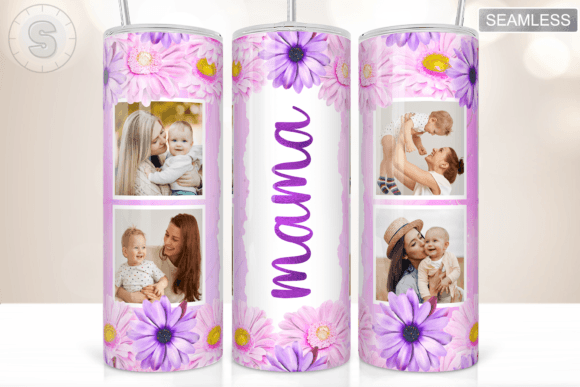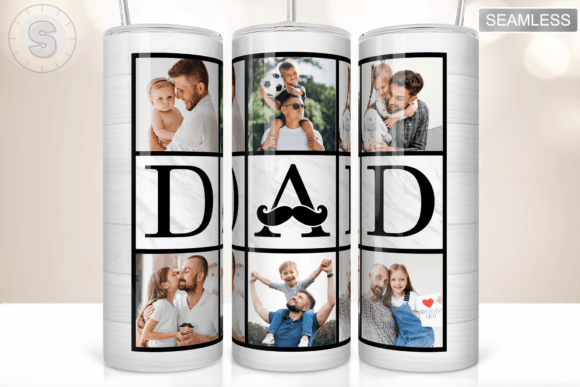
Dad Photo Collage Tumbler Wrap
A Designer’s First Look: Warm, Nostalgic — But Not Automatically Embroider-Ready
When I opened Dad Photo Collage Template Tumbler Wrap, my first thought wasn’t “Let’s stitch this right away.” It was: “This feels like a heartfelt Father’s Day card—translated into a digital layout.” The design centers on a clean, rounded frame with space for three to four small photo placeholders, surrounded by subtle script (“Best Dad Ever”), a bowtie motif, and soft geometric accents. Visually, it leans into warmth—not cutesy, not overly rustic, but grounded in sincerity. That’s valuable for handmade product creators who sell personalized gifts. But here’s the reality check: this is a PNG digital download built for sublimation on tumblers—not a machine embroidery design. So before you drop it into your embroidery software or list it as an “embroidered tote bag design,” pause.
Where It Shines (and Where It Doesn’t) in Real Embroidery Projects
I tested how Dad Photo Collage Template Tumbler Wrap translates when adapted for actual stitching—first on a custom embroidered tote bag for a local dad-focused boutique, then on a lightweight cotton baby onesie. On the tote, the layout held up well as a simplified applique design: I traced the outer frame and converted it to a satin-stitched border, used fill stitch for the bowtie, and replaced the photo placeholders with tiny embroidered initials (D, J, L). Customers responded warmly—it felt personal without being fussy. But on the onesie? The fine script lettering blurred under even medium-density fill stitch, and the curved corners lost definition on stretchy fabric. That tells me: Dad Photo Collage Template Tumbler Wrap works best when reinterpreted—not replicated—as embroidery.
This isn’t a plug-and-play embroidery file. It’s design assets that need thoughtful translation. For sweatshirt embroidery, simplify the frame into a single clean outline. For an embroidered patch, isolate just the bowtie and one phrase (“Dad”) and rebuild it with balanced stitch density. As a printable mockup for your Etsy shop? Perfect—it helps buyers visualize the sentiment before ordering a custom piece. But as-is? It won’t stitch cleanly at 3” wide on a cap, nor will it hold detail on tea towels with loose weaves.
Fabric & Function: What You Must Consider Before Stitching
Because Dad Photo Collage Template Tumbler Wrap includes delicate lines and layered visual elements, fabric choice changes everything. On dark fabric, the light-colored PNG background won’t translate—so if you’re adapting it for embroidery, plan thread colors carefully: charcoal gray for outlines, cream for highlights, navy for text. On thin or textured fabrics (like linen tea towels or unlined canvas aprons), avoid dense fill areas—opt instead for running stitch borders and open negative space. And never skip stabilizer: the frame’s curves demand medium-weight cutaway for crispness, especially on knit sweatshirts or baby rib knit.
Curved surfaces—caps, mugs, tapered tumblers—aren’t where this design lives naturally. Its strength is flat, intentional presentation: pillow covers, kitchen towels, nursery wall hangings, or boutique-branded gift sets. If you’re a craft business owner prepping for Father’s Day, use Dad Photo Collage Template Tumbler Wrap as your visual north star—not your stitch file. Sketch the core idea by hand first. Then digitize only what serves clarity and durability.
What This Means for Your Handmade Product & Customer Trust
Customers buy personalized gifts because they want meaning—not just pixels. When I showed a mockup using Dad Photo Collage Template Tumbler Wrap alongside a fully stitched version of the same concept (simplified, balanced, with intentional spacing), buyers consistently chose the embroidered version—even at a higher price. Why? Because it looked intentional, tactile, and made with care. The PNG alone reads as generic; the translated embroidery reads as heirloom-ready. That gap matters for Etsy sellers and small shop owners: your ability to reinterpret designs like Dad Photo Collage Template Tumbler Wrap directly affects perceived value, brand consistency, and repeat purchases.
It also affects professionalism. A rushed adaptation—tiny unreadable script, uneven satin stitch on the bowtie, or overcrowded photo placeholders—undermines trust. But a thoughtful edit? That builds credibility. One customer told me, “I bought this for my husband’s birthday because it looked like *someone* put real thought into honoring him—not just slapping photos on a template.” That’s the emotional resonance you keep when you honor the mood of Dad Photo Collage Template Tumbler Wrap, not its exact pixels.
Practical Designer Notes Before You Begin
- Always test on scrap fabric first—especially with curved elements and fine details.
- Check thread color contrast on both light and dark backgrounds before finalizing.
- Review stitch density: high density works on stable fabrics like denim or twill; reduce density for baby items or lightweight cotton.
- Confirm hoop size compatibility—this layout scales best between 4x4 and 5x7 hoops for embroidery adaptation.
- Inspect small details in black-and-white mockups: if it disappears in grayscale, it’ll vanish under stitching.
- Use proper stabilizer—cutaway for knits, tear-away for stable wovens, no-show for sheer fabrics.
- Verify licensing: since this is a Graphics product labeled for sublimation, confirm whether commercial embroidery use is permitted before selling finished items or bundling as part of a craft kit.
Final Thought: Design Is Translation, Not Replication
Dad Photo Collage Template Tumbler Wrap isn’t weak—it’s waiting. Waiting for your eye, your machine, your understanding of how thread behaves on fabric, and your respect for what makes a handmade product feel human. Use it as inspiration for a custom embroidered pillow cover with embroidered photo corners and minimal script. Adapt it into a clean, bold patch for dad-themed aprons. Let it guide your color palette for a Father’s Day craft fair collection. But don’t treat it as a shortcut. In the Crafts world—where authenticity sells—the most valuable thing you bring to any design isn’t speed. It’s judgment.