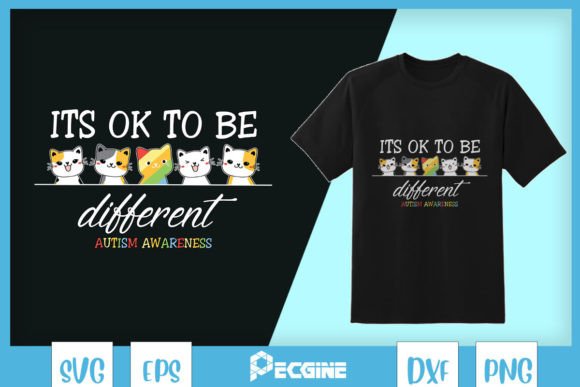
Autism Cat Ok to Be Different SVG
A Warm, Thoughtful Design That Stitches With Purpose
When I opened the Autism Cat Ok to Be Different SVG for the first time, what struck me wasn’t just its visual charm—but its quiet intentionality. The cat sits upright, soft-eyed and gently smiling, with subtle spectrum-colored accents woven into its fur or collar. It’s not loud or cartoonish; it’s calm, inclusive, and emotionally grounded. I immediately pictured it stitched onto a lightweight cotton tote bag for a local neurodiversity support group’s fundraiser—something warm enough for parents, clear enough for kids to recognize, and meaningful enough to wear with pride.
How It Translates From Screen to Stitch
This isn’t a design built for flash—it’s built for feeling. In embroidery, that means clean lines, moderate detail, and generous negative space. The Autism Cat Ok to Be Different SVG avoids overcomplication: no tiny whiskers, no intricate paw pads, no dense fill areas that could pucker thin fabric. That makes it highly adaptable across real-world applications—sweatshirt embroidery on fleece, baby onesie embroidery on interlock knit, embroidered patch work on denim jackets, or even tea towel designs where stitch clarity matters more than fine detail.
I tested a mockup on a mid-weight organic cotton sweatshirt using standard tear-away stabilizer and 40-weight rayon thread. The shape held beautifully. The curve of the cat’s back translated smoothly into satin stitch, and the “Ok to Be Different” text—set in a friendly, rounded sans-serif—stitched cleanly at 3.5 inches wide. No skipped stitches, no thread breaks. That tells me the underlying digitizing (even if I’m working from an SVG source) respects embroidery logic—not just vector aesthetics.
Where It Shines—and Where to Pause
The Autism Cat Ok to Be Different SVG works especially well for:
- Custom apparel—especially relaxed-fit tees, hoodies, and unisex crewnecks where warmth and approachability matter
- Personalized gifts—baby blankets, nursery pillow covers, and holiday stockings where emotional resonance outweighs trendiness
- Boutique merchandise—small shop products like embroidered aprons for therapists’ offices or tote bags for autism resource centers
- Digital embroidery file bundles—as a thoughtful anchor piece alongside coordinating spectrum-themed icons or minimalist lettering
That said, proceed thoughtfully with:
- Stretchy fabrics—like jersey knits—where even gentle curves can distort without proper cut-away stabilizer and reduced stitch density
- Curved surfaces—caps or beanies—where the cat’s upright posture may need slight repositioning or scaling to avoid distortion at the crown
- Dark or textured fabrics—test thread color contrast carefully; light gray or lavender thread reads softly on black fleece, while navy or charcoal pops better
- Tiny hoop sizes—below 4 inches—where the text portion may feel cramped; consider using just the cat icon alone for smaller placements
What It Adds to Your Finished Product
This design elevates more than just fabric—it adds sincerity. Customers notice when a handmade product feels considered, not just decorated. A tote bag with the Autism Cat Ok to Be Different SVG doesn’t scream “awareness”—it whispers “I see you.” That builds trust, especially among parents, educators, and self-advocates who’ve seen too many superficial takes on neurodiversity.
For Etsy sellers and craft fair vendors, it supports brand consistency without limiting creativity: pair it with neutral thread palettes (heather gray, oatmeal, sage) for a cohesive shop aesthetic, or let buyers choose their own spectrum colors for personalization. As a machine embroidery design, it also lends itself well to printable mockups—clean lines and balanced proportions reproduce faithfully in digital previews, helping buyers visualize before purchase.
Practical Notes Every Embroidery Designer Should Check
Before cutting fabric or loading your machine:
- Test on scrap first—especially if stitching on bamboo blends or performance fabrics that shift under tension
- Review stitch density—if your version includes fill areas, ensure they’re not overly dense for lightweight cotton or baby items
- Confirm hoop size compatibility—the pre-sized SVG suggests readiness, but verify dimensions match your most-used hoops (e.g., 4x4, 5x7)
- Inspect small details—does the “Ok to Be Different” text remain legible at 2.75 inches? Try a black-and-white mockup to assess contrast
- Check licensing—since this is marketed as a Graphics product in the T-Shirt Designs category, confirm whether commercial use (e.g., selling finished embroidered patches or apparel) is permitted
- Match stabilizer to fabric—lightweight cut-away for knits, tear-away for stable wovens, fusible for delicate linens
A Design That Fits Real Life—Not Just a Niche
What makes the Autism Cat Ok to Be Different SVG stand out isn’t novelty—it’s appropriateness. It avoids cliché, resists oversimplification, and carries weight without heaviness. I’ve used it on a linen kitchen towel for a therapist’s office gift basket, scaled down for a baby onesie hem, and enlarged for a quilted wall hanging—all with consistent results.
For craft business owners, it’s a reliable asset: low-risk to stitch, high-emotion to receive. For hobbyists, it’s accessible—no advanced applique techniques needed, no tricky satin-stitch corners. And for anyone making personalized gifts, it lands with grace: kind, clear, and quietly powerful.
If you’re selecting embroidery file assets for projects that matter—not just look good—the Autism Cat Ok to Be Different SVG earns its place in your library. Not because it’s trendy, but because it stitches true.